
Table of Contents
- Why Concessions Matter in Group Hotel Contracts
- The DIY Approach: Common Pitfalls When Negotiating Alone
- Limited Leverage Without Industry Relationships
- Hidden Risks in Self-Negotiated Contracts
- How Hotel Gurus Secures Maximum Concessions
- Our Multi-Property Negotiation Strategy
- Rate Protection, Attrition, and Cancellation Flexibility
- Upgrades, Fee Waivers, and Value-Add Benefits
- Speed and Efficiency: Days, Not Months
- Single Point of Contact Throughout Your Program
- Risk Protection That Protects Your Bottom Line
- Why Hotel Gurus Is Your Concession Advantage
- Frequently Asked Questions (FAQ)
Why Concessions Matter in Group Hotel Contracts
A hotel concession is far more than a nice extra. It’s a financial and operational safeguard that directly impacts your program’s profitability and flexibility.
When you negotiate group hotel contracts, concessions form the backbone of your deal’s true value. Beyond the base room rate, concessions include rate protection guarantees, flexible cancellation terms, attrition allowances, complimentary upgrades, waived fees, and reserved perks like breakfast or parking. These terms can mean the difference between breaking even and delivering a profitable program—or between executing smoothly and facing unexpected costs when attendee numbers shift.
Consider a corporate retreat of 150 rooms over three nights. A $5 per-room attrition allowance protects you if 10 rooms cancel (saving $150 in potential penalties). Waived resort fees for all attendees could save $3,000 across the block. A rate-lock provision shields you from price increases if you’re booking six months ahead. Complimentary suite upgrades for executives reduce your hidden management costs.
The hotels know this. They offer concessions strategically—sometimes generously, sometimes minimally—depending on who’s asking and how well they’re negotiated. Your job is to secure the maximum value your group and timeline deserve.
Actionable takeaway: Before your next group hotel negotiation, list the specific concessions that matter most to your program: rate protection, flexible cancellation, attrition allowances, or upgrades. Prioritize them by financial impact, then add them to your request list.
The DIY Approach: Common Pitfalls When Negotiating Alone
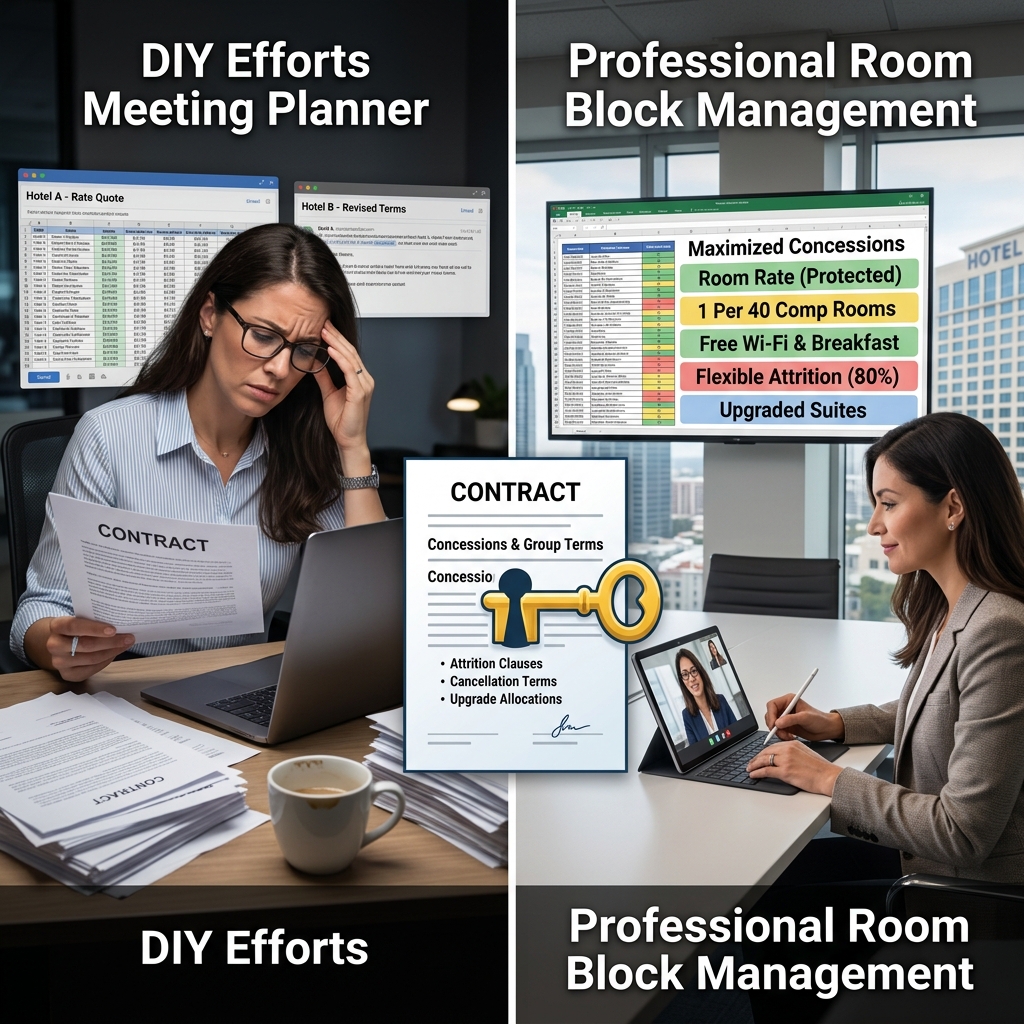
Handling hotel negotiations in-house sounds straightforward until you’re fielding emails from three hotel sales managers, managing multiple rate quotes in spreadsheets, and trying to compare apples-to-apples terms across different properties.
Most event planners and corporate coordinators don’t negotiate hotel contracts regularly—it’s one of dozens of tasks competing for attention. Hotels, conversely, do this all day, every day. Their sales teams have scripts, playbooks, and financial incentives to close deals on their preferred terms, not yours.
Common DIY pitfalls include:
Accepting the first offer as standard. Hotels often lead with conservative concession packages. Without benchmark knowledge, you may believe a single-digit attrition allowance and standard cancellation terms are non-negotiable when they’re actually soft starting points.
Negotiating rate in isolation. Many coordinators focus exclusively on the nightly room rate ($149 vs $155) and miss that concessions can add more value than a $1 rate reduction. A waived resort fee worth $25 per room per night is more impactful than a $2 rate cut.
Unclear contract language on critical terms. Vague attrition clauses, ambiguous cancellation deadlines, or undefined upgrade protocols create disputes months later. You might think you’ve negotiated flexibility only to discover the terms favor the hotel.
Back-and-forth fatigue. Email chains with sales managers stretch across weeks. You send a request, wait days for a response, counter-propose, wait again. Each cycle burns time and momentum, often ending when you accept whatever was last offered just to move forward.
Missing secondary benefits. Hotels extend perks beyond rate and cancellation—free meeting space, complimentary WiFi packages, room upgrades for loyalty program members, or discounted parking. DIY negotiators often miss these because they’re not explicitly listed in initial proposals.
The real cost isn’t just lost dollars; it’s the administrative burden and risk exposure that come with incomplete negotiations.
Actionable takeaway: Track your last three group hotel negotiations. Note how long each took and whether you achieved your concession targets. If negotiations stretched beyond two weeks or you settled for less than your priority list, professional support could have accelerated and improved outcomes.
Limited Leverage Without Industry Relationships
Hotels negotiate differently depending on who’s across the table. A meeting planner making her first call carries less influence than an established broker with ten active group programs and a pipeline of future business.
We have deep, long-standing relationships with hotel sales directors, revenue managers, and ownership across every major market globally. These relationships mean hotels prioritize our calls, respond within hours, and offer more creative solutions than they might extend to one-off requests.
When you negotiate independently, the hotel has no incentive to invest heavily in your deal—you’re a transactional interaction, not an ongoing partner. Their sales manager takes your request, plugs numbers into a system, and returns standard terms. If you push back, escalation is slow or non-existent.
Our model is different. Hotels know that serving our clients well builds the relationship for future business. We bring recurring volume, flexible groups across multiple seasons, and repeat bookings. That position lets us unlock:
Priority rate access. Hotels release their best allocation and pricing tiers to trusted partners first. We see rates other bookers don’t encounter until they’re picked over.
Custom concession packages. Rather than choosing from pre-built options, we negotiate tailored terms: a higher attrition allowance for a program with uncertain attendance, extended cancellation windows for a corporate group with shifting dates, or complimentary suites for a boutique property focused on VIP experience.
Flexibility on timing and modifications. Last-minute group size changes, date shifts, or contract amendments are handled with goodwill when you have an established relationship. DIY negotiators often face rigid policies and re-quoting delays.
Access to property owners and GMs. For significant bookings or strategic partnerships, we can escalate directly to senior leadership rather than working only through sales departments.
This leverage advantage isn’t about being pushy—it’s about being trusted. Hotels know we’ll deliver our groups on time, communicate clearly, and resolve issues efficiently. That trust translates into tangible concessions and flexibility that first-time negotiators simply cannot access.
Actionable takeaway: Evaluate your hotel relationships. Do you have direct contact with decision-makers? Do hotels respond within 24 hours? If hotels treat your requests as routine transactions, you’re leaving concessions on the table.
Hidden Risks in Self-Negotiated Contracts
Many DIY negotiations produce signed contracts that look complete—until problems emerge after the deal closes.
Attrition clauses are a prime example. A contract might state “10% attrition applies after that date.” What that actually means often depends on whether you’re counting occupied rooms, reserved rooms, or revenue. One interpretation could cost you $10,000; another is penalty-free. Most DIY coordinators don’t catch the ambiguity until billing.
Cancellation terms present another risk. You might believe you can cancel 50 rooms at 21 days notice, only to discover the contract fine-print requires 30 days and the hotel enforces it strictly. That’s a booking flexibility you thought you had but didn’t.
Rate protection gaps leave you exposed during volatile markets. A contract might lock your rate but exclude taxes, resort fees, or destination charges, which can increase unexpectedly. You think you’ve protected your budget and then face add-ons.
Fee waivers are often incomplete. You negotiate waived resort fees but the contract doesn’t explicitly exempt certain categories (late checkout fees, convenience store charges, phone calls). You’re billed for items you thought were covered.
Upgrade protocols sound simple until execution. You negotiate “complimentary suite upgrades for VIP attendees” but the contract doesn’t specify how rooms are assigned, who qualifies, or what happens if the hotel runs out of suites. At arrival, disputes emerge about who gets upgraded.
These aren’t rare edge cases—they’re systematic risks in contracts negotiated without expert review. Hotels aren’t acting maliciously; they’re simply interpreting ambiguous language in ways that protect their interests.
We build specificity into every contract. Our language defines attrition calculations precisely, locks rate guarantees comprehensively, establishes clear upgrade protocols, and closes loopholes before signing. We also maintain communication with the hotel post-signing to ensure execution matches the negotiated intent.
Actionable takeaway: Pull a signed hotel contract from a past program. Read the attrition clause, cancellation terms, and fee sections aloud. If you encounter ambiguous language or undefined terms, you’ve identified risk that could cost money later.
How Hotel Gurus Secures Maximum Concessions
Our approach to concession negotiation is systematic, informed by years of high-stakes event logistics and thousands of group bookings.
We begin by understanding your program deeply: event dates, group size, target markets, attendance uncertainty, budget constraints, and strategic priorities. A corporate incentive program for 200 executives has different concession needs than a 50-person production team shoot or a 1,000-room conference. We tailor our negotiation strategy accordingly.
Next, we identify the optimal hotel set across your target markets. Rather than negotiating a single property, we develop multiple competitive options within days. This approach serves two purposes: it gives your team genuine choices, and it creates competitive tension that benefits our negotiation leverage with each property.
We position each property strategically. Rather than requesting standard concessions across the board, we highlight each hotel’s competitive advantages and anchor our ask to those strengths. A luxury property might lead with rate lock and premium upgrade packages. A mid-scale option might emphasize generous attrition allowances and flexible cancellation windows. This positioning makes each request feel thoughtful rather than generic, increasing hotel willingness to say yes.
Once proposals come back, we don’t accept first offers. We counteroffer systematically, combining rate, concessions, and terms into comprehensive packages. A hotel might come back with a lower rate but tight attrition; we reposition to accept a slightly higher rate if they extend cancellation flexibility. We’re trading variables strategically, always optimizing total program value rather than fixating on any single metric.
Our team also negotiates elements that DIY planners often miss: meeting space rental waivers, complimentary WiFi upgrades, parking discounts, audio-visual pricing, welcome amenity credits, and extended early check-in/late checkout windows. These individual items compound into significant total value.
Finally, we document everything with crystal clarity. Our contracts use plain language for critical terms, define ambiguous concepts, and build in interpretation rules that protect both parties but lean protective toward your program.
Our Multi-Property Negotiation Strategy
Instead of requesting one hotel and hoping the concessions are competitive, we operate from a position of multiple options.
Within days of your booking request, we present 3-5 viable hotels across your target locations with full rate, concession, and term proposals. You’re not seeing generic information—each proposal reflects our direct communication with that property’s sales and revenue teams.
This multi-property approach creates natural competitive dynamics. Hotels know we’re presenting alternatives. They see that strong concessions on your request might win the deal; weak concessions likely mean you’ll choose a competing property. That competitive reality motivates them to front-load their best offers rather than making you negotiate exhaustively.
It also gives your team informed choice. Rather than defaulting to the hotel you’ve used before or the one that came up first, you evaluate options side-by-side. One property might offer superior rate and flexibility; another might deliver better amenities and upgraded accommodations for your guests. You’re making strategic decisions based on complete information.
For your team, this eliminates the burden of shopping multiple hotels independently. We consolidate options, manage all conversations, and present clear comparison frameworks so you can evaluate quickly and decide confidently.
Actionable takeaway: Request options across 2-3 different hotel brands and price points, not just one property. You’ll immediately see how concessions vary and which properties are truly competitive for your group.
Rate Protection, Attrition, and Cancellation Flexibility
These three contract elements form the risk-management foundation of every group booking. Together, they protect your program if circumstances change.
Rate protection locks your negotiated per-room rate regardless of market fluctuations between now and your event. In volatile markets or when booking far in advance, rate locks save thousands. We negotiate locks that cover all room types, all nights, and exclude surprise add-ons like taxes or destination fees.

Attrition terms define what happens if your group size declines. Rather than charging penalties for every cancelled room, attrition allowances let you shed rooms without penalty up to a threshold. We routinely negotiate 10-15% attrition allowances (meaning you can cancel up to that percentage of reserved rooms penalty-free). For programs with uncertain attendance or late registrations, we sometimes secure higher allowances or graduated attrition structures that give you more flexibility early in the booking window and tighten closer to arrival.
Cancellation flexibility addresses what happens if your entire program shifts or cancels. We negotiate extended cancellation windows (often 30-45 days before arrival) with reduced or waived penalties if you cancel within defined timeframes. For high-risk programs, we’ve secured 60+ day windows or limited-liability cancellation terms that cap penalties at a percentage of total revenue rather than full room costs.
Each of these terms is negotiable. The default terms hotels propose are conservative and favor them. Our job is to push those terms toward equity—balancing the hotel’s need for revenue certainty with your program’s legitimate operational needs.
We also build interdependency into these negotiations. A hotel willing to lock rate for longer might want stricter attrition terms. A property offering generous cancellation windows might request a higher room rate. We frame these trade-offs transparently so you understand what you’re gaining and conceding.
Actionable takeaway: Before signing any hotel contract, confirm three specifics: (1) What date does the rate lock end? (2) What percentage attrition is allowed, and when does that deadline expire? (3) What cancellation terms apply, including penalty windows and amounts?
Upgrades, Fee Waivers, and Value-Add Benefits
While rate locks and attrition terms protect your financial risk, upgrades and fee waivers deliver tangible guest value and improve program economics.
We negotiate tiered upgrade packages. Executive attendees receive complimentary suite upgrades and lounge access. Standard attendees receive room-category upgrades at arrival based on availability. These upgrades increase guest satisfaction without increasing your room cost and distinguish your program from standard hotel stays.
Fee waivers are high-impact. Resort fees ($25-45 per room per night) add up quickly across a 200-room group. We negotiate full waivers or negotiate discounted rates that reduce the per-night charge from $35 to $15, for example. Internet fees, parking charges, and facility-use fees are similarly negotiable. For a three-night event with 100 rooms, fee reductions can save $5,000-$10,000.
Beyond standard concessions, we pursue property-specific value-adds: complimentary meeting space, discounted food and beverage pricing, complimentary WiFi upgrade to premium tiers, welcome amenity credits ($10-$20 per attendee), extended early check-in windows, or discounted airport shuttle passes. These benefits enhance guest experience while improving your total program value.
For VIP attendees or executive groups, we negotiate relationship perks: room upgrades, welcome amenities, late checkout, lounge access, or dining credits. These touch-points create memorable experiences without increasing your hotel cost significantly.
We also factor in ancillary revenue opportunities. For larger groups, we negotiate negotiated catering minimums or meeting space rental terms that you can pass through to sponsors or recover as program revenue.
The cumulative value of upgrades and fee waivers often exceeds the savings from a $2-$3 per-night rate reduction. Your guests feel the benefit directly—they experience upgraded rooms, complimentary parking, included breakfast—while your program budget improves measurably.
Actionable takeaway: List the top five guest-facing benefits you want for your program (suite upgrades, waived parking, complimentary breakfast, lounge access, extended checkout). Use this list as your baseline for every hotel negotiation.
Speed and Efficiency: Days, Not Months
Event timelines are unforgiving. A conference booking 12 months out, a production shoot on four-week notice, a corporate retreat with evolving logistics—each requires hotel sourcing and negotiation on tight schedules.
DIY hotel sourcing averages 4-8 weeks from initial inquiry to signed contract. You research properties, make cold calls, exchange emails, wait for proposals, compare terms, counter-offer, and negotiate. Each cycle adds days. If you’re coordinating alongside a dozen other planning tasks, hotel negotiations slide down your priority list or stretch even longer.
We deliver hotel options within days. Upon receiving your requirements (dates, location, group size, concession priorities), we immediately activate our network. We’re calling properties, submitting detailed RFPs, and collecting competitive proposals simultaneously. Within 48-72 hours, you have 3-5 solid options with complete rate and concession details.
This speed is possible because we’ve already built relationships with hotel sales teams. We’re not making cold calls or introducing ourselves; we’re asking trusted partners to prioritize our request. Hotels respond faster to us because they know our requests are serious and our groups are reliable.
Our turnaround also reduces decision fatigue. Rather than receiving proposals over weeks and re-evaluating as new options arrive, you receive a complete set of options simultaneously. You make your decision from a full picture rather than incrementally accepting partial information.
For time-sensitive programs—a last-minute corporate event, a production with compressed pre-production, a conference that just secured a new date—our speed is invaluable. We’ve booked significant group programs in 10 days from initial inquiry to signed contract.
Even for programs with longer timelines, early negotiation accelerates other planning. Once your hotel is secured, your attendees have accommodation confirmed, your budget is locked, and your logistics team can focus on other program elements. There’s no advantage to delaying hotel booking; there’s substantial advantage to solving it quickly.
Actionable takeaway: Calculate how many hours you spent on hotel research, comparison, and negotiation for your last program. Multiply by your loaded hourly rate. Add any opportunity cost from delayed decisions. That’s the true cost of DIY hotel sourcing.
Single Point of Contact Throughout Your Program
Once your hotel is booked, coordination doesn’t end—it evolves. Group size changes, rooming lists need adjustment, VIP requests emerge, logistics questions arise at arrival, billing issues require clarification.
In DIY models, you manage these updates directly with the hotel. That means emailing the sales manager, potentially waiting for responses across time zones, repeating context repeatedly, and managing ambiguity when interpretations differ. If the original negotiator leaves your organization, incoming coordinators must rebuild relationships and relearn your contract terms from scratch.
We serve as your single point of contact from signing through post-event reconciliation. All communication flows through our team. We track every detail of your booking, understand your program priorities and contingencies, and act as your advocate with the hotel. When you need a rooming list adjustment, you email us once; we coordinate with the hotel and confirm back to you. When a billing question arises, we investigate, clarify, and resolve it.
This centralized communication creates efficiency. Your team doesn’t juggle multiple hotel contact numbers or struggle with conflicting information. There’s no confusion about who has decision-making authority for changes or exceptions.
It also protects your interests. We track your contract terms consistently and ensure the hotel honors agreed concessions. If waived fees appear on billing or promised upgrades don’t materialize, we catch discrepancies and resolve them before final payment.

For multi-property programs (conferences across three cities, productions shooting in multiple locations), this coordination benefit multiplies. Rather than managing separate relationships with three hotel sales teams, you work with one partner who’s coordinating all three properties.
This approach transforms the hotel relationship from transactional to partnership. The hotel knows your program priorities, your flexibility limits, and your operational needs. They’re invested in your success because they have a trusted advocate managing the relationship long-term.
Actionable takeaway: Identify your primary hotel contact for an upcoming program. Confirm they’ll be available for pre-event planning, on-site support, and post-event billing. If responsibility passes between people, ask who owns the transition. If you can’t get a clear answer, it’s a coordination gap.
Risk Protection That Protects Your Bottom Line
Group hotel programs carry inherent financial and operational risk. Attrition, market rate changes, contract disputes, billing errors, and execution gaps can all impact your program profitability or produce unexpected costs.
Professional contract negotiation and management directly mitigate these risks.
Clearly negotiated attrition and cancellation terms protect you if group dynamics shift. Rather than absorbing penalties for every cancelled room, negotiated allowances give you legitimate flexibility without financial penalty.
Comprehensive rate locks and fee clarity prevent surprise billing. You know exactly what you’ll pay per room per night, taxes included if applicable, resort fees waived or capped, and any other costs baked into your rate. There are no hidden charges at final billing.
Well-documented concession details prevent post-event disputes. Upgrade protocols, fee waivers, and benefit dates are written clearly enough that execution issues rarely arise. If they do, your documentation makes resolution straightforward.
Contract language that anticipates contingencies (how group size changes are handled, what happens if dates shift, how rooms are assigned) prevents ambiguity from becoming liability. Rather than discovering loopholes at the last minute, you’ve addressed scenarios upfront.
For programs carrying significant financial exposure—a 500-room conference with multi-year contracts, a production with uncertain attendance estimates, a corporate retreat with executive-level scrutiny—professional contract management protects your reputation and bottom line.
We also carry institutional knowledge about industry practices, hotel policies, and common pitfalls. We identify risks in contract language before you sign, propose protective amendments based on experience, and flag contingencies that DIY negotiators often miss. That risk foresight has prevented countless program headaches and cost overruns.
Actionable takeaway: For your next program, identify the top three financial or operational risks: group size uncertainty, date changes, budget volatility, or execution issues. Discuss these risks with your hotel partner explicitly and ensure your contract addresses them. If you’re not sure how to address a risk contractually, that’s a signal to seek expert guidance.
Why Hotel Gurus Is Your Concession Advantage
Negotiating maximum group hotel concessions requires three things working together: industry relationships that give you leverage, negotiation expertise that optimizes every term, and speed that fits real event timelines.
We deliver all three.
Our relationships with hotels globally mean your requests receive priority attention and creative solutions. Hotels are willing to extend stronger concessions to us than they would extend to one-off negotiators because we bring reliable volume and operate as trusted partners.
Our team understands the complex interplay between rate, attrition, cancellation terms, and upgrades. We don’t optimize for a single metric. We optimize for total program value, understanding that a higher rate with generous concessions might deliver better true cost than a lower rate with rigid terms. We trade variables strategically, counteroffering with precision, and understanding when to push and when to accept trade-offs.
Our speed eliminates the months-long back-and-forth that consumes your planning time and often results in compromised terms. We deliver options within days so you’re not racing to meet event timelines.
Our single-point-of-contact model means you’re not managing hotel relationships; we are. You focus on your event. We handle the hotels.
Most importantly, our service is completely free to you. Hotels pay us, not you. You get expert negotiation, leverage, and ongoing program management without increasing your costs. That makes professional support a pure value-add with no financial downside.
If you’re currently managing group hotel negotiations in-house, we encourage you to evaluate what you’re trading: time, concession optimization, contract clarity, and ongoing coordination. For many programs, outsourcing hotel management unlocks money and time you’re leaving on the table.
Ready to see how much better your next group hotel negotiation could perform? Get started by sharing your event details and timeline. We’ll deliver competitive options within days and show you what maximum concessions actually look like.
Frequently Asked Questions (FAQ)
What concessions can we actually negotiate into a group hotel contract?
We secure a range of protections and value-adds tailored to your program, including rate protection guarantees, flexible attrition and cancellation terms, complimentary upgrades for VIPs, waived resort fees, and complimentary suite upgrades or meeting space. Our negotiations focus on what matters most to your event—whether that’s reducing financial risk or enhancing attendee experience. We handle all back-and-forth with hotels so you get concrete terms in writing before committing.
How quickly can we source options and finalize a hotel agreement?
We typically provide multiple vetted hotel options within days, not weeks or months. Our global relationships and streamlined process mean we move fast without sacrificing quality or negotiation strength. Once you select a property, we manage contract negotiations and secure your favorable terms so you can move forward with confidence.
Why does it cost nothing for us to help you secure better hotel rates and concessions?
Hotels pay us for our sourcing and negotiation services, not you. Our revenue comes from the properties we book, which aligns our incentives with yours—we succeed when we secure the best rates and terms for your program. This means you get expert support, global options, and aggressive negotiations at zero cost to you.


