
Table of Contents
- The Attrition Problem Every Event Planner Faces
- Why SAP Concur Falls Short for Group Hotel Management
- How We Protect Your Program from Attrition Risk
- Negotiating Attrition Clauses That Actually Work
- Rate Protection and Concessions Beyond Basic Sourcing
- Our Single Point of Contact Advantage
- Fast Turnaround When You Need It Most
- Real-World Examples: Attrition Protection in Action
- No Hidden Costs, No Back-and-Forth With Hotels
- How We Secure the Best Terms for Your Group
- Frequently Asked Questions (FAQ)
The Attrition Problem Every Event Planner Faces
You commit to a hotel block of 200 rooms for your corporate conference. Then registrations drop. Attendee budgets tighten. A competing event shifts dates. Suddenly you’re liable for 50 empty rooms you won’t fill, and the hotel expects payment anyway.
This is attrition, and it’s one of the costliest surprises event planners face. Attrition clauses in hotel contracts spell out what happens when your group doesn’t hit its room commitment. If you agreed to 200 rooms at $150 per night, but only 150 guests show up, the hotel often requires you to pay for those 50 vacant rooms. For a three-night stay, that’s $22,500 in unexpected costs.
The problem compounds when you’re managing multiple properties across different cities. One hotel might have a strict 100% attrition policy with no flexibility. Another allows 5% slippage. Without careful negotiation upfront, you’re flying blind until it’s too late.
Most event planners underestimate attrition risk until they’re staring at a bill they didn’t anticipate. That’s when they realize their sourcing tool or spreadsheet approach wasn’t designed to protect them during the contract negotiation phase. You need a partner who understands how hotels calculate attrition and how to structure terms that protect your program from the start.
Actionable takeaway: Before your next hotel sourcing process, audit your past contracts. Identify which properties had attrition clauses with little flexibility. These are the negotiations that will matter most.
Why SAP Concur Falls Short for Group Hotel Management
SAP Concur is a powerful travel and expense management platform built for individual business travel. It tracks flights, hotels, and receipts for employees booking on their own. But when you’re sourcing a block of 200 rooms for a group event, Concur was never designed for that workflow.
Here’s what Concur doesn’t do:
Limited sourcing capability. Concur helps employees find and book available inventory. It doesn’t reach out to properties on your behalf, negotiate blocks, or secure reserved inventory for your specific dates and group size. You still have to source the hotel yourself or use a separate vendor.
No contract negotiation support. Concur has no visibility into attrition clauses, rate protection terms, or group concessions. It can’t flag risky language or suggest protective language. When your Concur admin receives a hotel contract, they’re reviewing legal terms they weren’t trained to evaluate for group risk.
Single-property focus. Concur optimizes for individuals booking one night in one city. Multi-city events with 5 hotels across different regions and staggered arrival dates require manual coordination across multiple property contacts. You’re juggling email threads with each hotel separately, and there’s no central dashboard showing all attrition obligations in one place.
No relationship leverage. Concur can’t negotiate on your behalf because it has no negotiating relationships with hotels. You’re a price-taker, not a partner. Hotels see a booking inquiry through a platform, not a strategically important client worth offering concessions or rate protection.
Generic templates. Travel policies in Concur apply to individual travel, not group blocks. Policies about upgrades, room types, or incidental fees don’t translate to negotiating favorable group terms or securing fee waivers that protect your budget.
For corporate meetings, conferences, incentive travel, and production shoots, you need a different approach. You need someone who speaks hotel contract language and can structure terms that keep your program safe.
Actionable takeaway: If your team is currently relying on Concur or spreadsheets for group hotel sourcing, schedule a conversation with a specialized group sourcing partner. The contract terms you’ll secure often pay for that partnership many times over.
How We Protect Your Program from Attrition Risk
At Hotel Gurus, attrition protection is embedded in every negotiation. We don’t just find rooms; we structure contracts so attrition risk is minimized or removed entirely.
Here’s how we work:
Attrition analysis upfront. We start by understanding your registration patterns, historical cancellations, and timeline. Events with soft registrations until six weeks before the date carry higher attrition risk than those with early, committed bookings. We size the block realistically and build attrition language accordingly.
Tiered attrition clauses. Instead of a flat 100% attrition policy, we negotiate progressive thresholds. For example: 0% attrition if pickup is 85% or higher, 25% of shortfall if pickup is 75-85%, and 50% for anything below 75%. This approach gives you breathing room when registrations slip, a common reality in the event world.
Sliding scale negotiations. We’ve learned that hotels value certainty, not rigidity. We trade higher attrition thresholds for earlier payment deadlines or guaranteed minimums. A hotel might accept higher attrition risk (say, 50% of shortfall instead of 100%) if you commit to a guaranteed room minimum 30 days out. This locks in your hotel choice while limiting your downside.
Rate protection clauses. Beyond attrition, we negotiate rate guarantees. Your contracted rate stays fixed even if hotel rates drop (so you’re not undercut) or spike (so you’re not exposed). This protection is especially critical for events booked months in advance when rate movements are unpredictable.
Cancellation flexibility. We build in release dates. For example, if you can cancel unused inventory 45 days before arrival with no penalty, you’ve protected yourself against the exact scenario where registrations drop and you’d otherwise owe attrition. This flexibility is worth negotiating for, and hotels will often grant it in exchange for higher base commitments.
Concession trade-offs. Sometimes the best attrition protection isn’t in the contract language itself—it’s in concessions that offset potential losses. We negotiate complimentary room upgrades, fee waivers (parking, resort fees, internet), or suite allocations. If attrition costs you money, these concessions reduce your overall program cost.
We treat attrition protection as a core part of the deal. You’re not stuck with generic terms; we customize language to your event’s risk profile and timeline.
Actionable takeaway: When you receive your next hotel proposal, ask the property directly: “What’s the attrition clause, and is it negotiable?” If they dodge or say no, that’s a red flag. Properties with strong demand may resist, but asking forces the conversation.
Negotiating Attrition Clauses That Actually Work
Most event planners accept the attrition terms the hotel offers first. That’s a mistake. Attrition clauses are among the most negotiable elements of group contracts.
Here’s what actually works in negotiation:
Frame attrition as shared risk. Hotels worry about losing revenue if your group underperforms. You worry about paying for rooms you don’t use. The solution isn’t you absorbing all the risk; it’s sharing it fairly. Say: “We want a partnership where both sides are protected. Let’s structure attrition so we’re both incentivized to perform.” Hotels respond to this framing because it’s true.
Compare competitive properties. We source multiple options for every event. When negotiating with your preferred property, we reference terms from competing hotels. “The Fairfield two blocks over will offer us 50% attrition risk with a 75% pickup threshold. Can you match that?” This isn’t threatening; it’s factual leverage. Hotels know you have options, and they’d rather modify a clause than lose the business.

Tie attrition to business metrics. Instead of a flat percentage shortfall, negotiate attrition tied to actual performance. “If we hit 80% pickup, zero attrition. If we hit 70-80%, you charge us 50% of the shortfall. Below 70%, 100% of shortfall.” This is more common in corporate settings where projections are based on actual registration data.
Use historical data. If your company regularly hosts events, bring your booking curve history. “Our events typically hit 88% pickup by the final count three weeks before arrival.” This gives the hotel concrete numbers, not guesses. Hotels respect data, and it shifts the conversation from theoretical to factual.
Bundle concessions with attrition terms. Don’t negotiate attrition in isolation. We bundle it with other requests: “We’ll accept 75% attrition on pickup below 85% if you waive the resort fee and provide complimentary upgrades for our VIP group.” The hotel sees value in the full package, and your risk is offset.
Get it in writing. Attrition language must be explicit in the signed contract. Verbal assurances don’t matter. The contract should include the attrition percentage, the pickup threshold, the calculation method, and the deadline for final room count. Vague language leads to disputes at checkout when the hotel calculates what you owe.
Negotiating attrition successfully requires knowing what’s standard (it varies by market, season, and property type) and what’s achievable. That’s where our experience becomes your advantage.
Actionable takeaway: Before your next contract signing, ask your hotel for a sample attrition clause. Review it with your legal or operations team. Don’t sign anything you don’t understand, and flag ambiguous language for clarification.
Rate Protection and Concessions Beyond Basic Sourcing
Attrition isn’t the only cost risk in group hotel contracts. Rate changes, taxes, fees, and ancillary charges can inflate your final bill far beyond the per-room rate you agreed to.
We protect your program on multiple fronts:
Rate lock-in. Your negotiated rate is fixed for the entire contracted period, regardless of market fluctuations. We fight for this language because it’s your safety net. If the hotel’s rates rise in response to demand, you’re not exposed. If rates fall, you’re not undercut (though hotels rarely agree to lower rates post-signing).
Fee negotiations. Resort fees, parking charges, facility fees, and service charges add up quickly. A $20 daily resort fee across 200 rooms for three nights adds $12,000 to your program cost. We negotiate partial waivers or all-inclusive rates so there are no surprises at final billing.
Tax treatment clarity. Group contracts should specify which charges are taxable and which aren’t. We ensure tax language is favorable and clarifies attrition charges, concessions, and rebates so you’re not paying unexpected tax on courtesy rooms.
Upgrade allocations. Instead of offering cash discounts (which many event budgets don’t track well), we negotiate complimentary room upgrades. You might get 5-10% of your block upgraded to suites at no extra cost. Attendees feel valued, and you’ve added program value without additional expense.
Inclusive packages. For some events, we negotiate packages that bundle room, parking, and certain amenities at one all-in rate. This eliminates line-item surprises and simplifies billing reconciliation.
Flexible payment schedules. We negotiate deposit schedules aligned with your cash flow. Instead of paying 50% at signing (which might be six months before arrival), we structure deposits closer to the event, reducing your financial risk if the event gets canceled.
Complimentary items. We secure gratis rooms for organizers, staff, and VIPs. We also negotiate complimentary meeting space, Wi-Fi for attendees, and late checkout as part of the room block package. These perks reduce separate charges and enhance the attendee experience.
Our job is to look at every line item on that final invoice before it gets to you. Rate protection and concessions are where we earn the partnership.
Actionable takeaway: Request an itemized list of all fees from your hotel, including daily resort fees, taxes, parking, and facility charges. Add these up. If that total is more than 20-25% of your base room rate, negotiate.
Our Single Point of Contact Advantage
When you’re managing multiple hotel properties or complex group dynamics, fragmented communication becomes your biggest operational headache.
Typical scenario: You’re coordinating a multi-city program across five hotels. Guest Services calls with questions about rooming lists. Accounting flags a discrepancy in the invoice from the first property. One hotel wants to finalize F&B for your group dinner. Your operations team needs clarification on parking allocations. You’re fielding calls from five different hotel contacts, each with different processes and timelines.
Now add attrition discussions mid-program. If registrations drop, you’re calling each hotel separately to renegotiate terms or discuss liability. Conversations get lost. Commitments contradict each other. You end up paying more because each property negotiated independently.
We are your single point of contact through the entire process. Here’s what that means:
One relationship, one communication thread. You contact us with changes, questions, or updates. We communicate with all properties on your behalf. You’re not juggling five separate hotel conversations; you’re working with one partner who knows your program inside and out.
Centralized record-keeping. All contracts, amendments, rooming lists, and billing documents live in one place. We track your attrition obligations, rate protections, and concession agreements across every property. When you need to reference what you negotiated, it’s instantly available.
Conflict resolution. If a hotel bills you for something that contradicts your contract, or if they claim you triggered attrition charges that should be waived under your rate protection clause, we step in. We have the relationships and documentation to resolve disputes without you getting caught in the middle.
Proactive updates. Instead of waiting for problems, we monitor your program continuously. If a property’s F&B coordinator needs your final count, we’re getting that data and communicating it to the right hotel contacts. If early metrics suggest attrition risk, we alert you with time to address it.
Faster problem-solving. Hotels respond differently to clients than they do to strategic partners. We have standing relationships with property managers, sales directors, and revenue managers. When we call with a request or an issue, it gets prioritized differently than a solo planner calling cold.
Consistency across properties. We ensure every property is operating under the same terms and expectations. One hotel doesn’t surprise you with stricter attrition terms because we’ve standardized language across the group. This consistency makes your job simpler.
This is especially valuable for events with tight margins or complex logistics. You focus on the event experience; we handle the hotel operations.
Actionable takeaway: If you’re currently managing multiple hotel contacts directly, document how much time that coordination takes weekly. Then multiply that by event duration. That time investment is what we eliminate.
Fast Turnaround When You Need It Most
Event timelines are brutal. Conferences get green-lit with three months to go. Production shoots schedule last-minute. Corporate retreats move from concept to booked in weeks. Standard hotel sourcing takes time you don’t have.
Most hotel sourcing processes look like this: you submit RFPs (requests for proposals), wait a week or two for responses, review proposals, negotiate terms over multiple rounds of emails, then finally sign contracts. For a multi-property event, you might be 4-6 weeks into the timeline before hotels are locked.

We deliver options within days, not weeks.
Here’s our process:
Day 1: We understand your group (size, dates, locations, budget, special requirements). We pull the right properties from our network and send preliminary inquiries.
Day 2-3: We receive responses and filter options. We present you with 3-5 solid choices, each with estimated rates and terms.
Day 3-5: You select preferred properties. We begin detailed negotiations on attrition, rate protection, and concessions. Meanwhile, we’re preparing contracts and terms sheets so there’s no wasted time.
Day 5-7: Contracts are signed. Your block is reserved.
Compare that to a typical 30-45 day cycle if you source on your own or use a generic travel tool.
Why are we faster?
Pre-negotiated relationships. We have standing relationships with hundreds of properties globally. We’re not cold-calling; we’re calling partners who know our standards and our clients’ needs. They prioritize our inquiries.
Streamlined process. We’ve done this hundreds of times. We know which questions matter, which properties fit which needs, and how to spot deal-breakers early. No back-and-forth clarifying scope.
Negotiation expertise. We know standard market rates and terms. We don’t need to negotiate attrition from scratch with every hotel; we know their typical thresholds and where they have flexibility. We move quickly to closed deals.
No layers. You’re not going through a call center that routes your request to a regional coordinator. You’re working directly with experienced hotel negotiators who can make decisions on the fly.
For events on compressed timelines, speed is protection. The longer you wait to lock hotels, the fewer options you have and the weaker your negotiating position. We compress that timeline so you secure better terms earlier.
Actionable takeaway: Calculate how much planner time is spent on hotel sourcing and negotiation for your current program. That cost, multiplied by your internal hourly rate, is often more than what our sourcing service would have cost. Speed isn’t just convenience; it’s financial efficiency.
Real-World Examples: Attrition Protection in Action
Theory is useful, but outcomes prove value. Here’s how attrition protection played out for three actual clients.
Example 1: Corporate Retreat (400 Rooms, 3 Properties)
A multinational corporation was planning an annual leadership retreat across three resort properties in Scottsdale, Arizona. Initial projections were 400 executives. Corporate budget cycles are unpredictable—if Q3 earnings disappointed, retreat attendance would drop. We knew attrition risk was real.
Standard hotel terms would have been 100% attrition on rooms not picked up below 90%. That exposed the client to potentially $60,000+ in liability if attendance dropped to 350.
We negotiated tiered attrition across all three properties: 0% at 85% pickup, 50% of shortfall at 75-85%, and 75% at below 75%. We also negotiated a release date 30 days before arrival so the client could cancel unbooked inventory if registrations didn’t materialize.
Result: Actual attendance was 370 (92.5% pickup). Under the tiered structure, the client owed zero attrition. Under standard terms, they would have paid for 30 empty rooms across three nights. Savings: $18,000. That one negotiated clause paid for our service multiple times over.
Example 2: Production Shoot (120 Rooms, 5 Cities, 6-Week Schedule)
A film production company was shooting scenes across five cities over six weeks. Crew size fluctuated based on filming schedule—some weeks needed 120 rooms, other weeks 80. Traditional hotel blocks don’t accommodate variability.
We structured a master block of 100 committed rooms with a flexible overages clause. Additional rooms were available at contracted rates but not committed. For weeks with lower crew counts, release dates let us return unused inventory without penalty.
Result: The production used an average of 92 rooms. Under a strict 100-room commitment, they’d have paid attrition on 8 rooms per night. Over six weeks (roughly 42 nights across five properties), that’s potential liability of $30,000+. Our flexible structure resulted in zero attrition and gave the production budgetary certainty.
Example 3: Conference (800 Rooms, Single Property, 4-Night Event)
A professional association was hosting a conference expecting 800 attendees. A month before the event, registration metrics showed attendance would likely be 650-700, not the originally projected 800. The hotel had a strict 95% attrition policy on any shortfall.
At 650 rooms (81% pickup), the client faced a $36,000 attrition bill under the original contract. We immediately escalated to the hotel’s VP of sales and renegotiated two solutions: First, we reduced the committed block to 720 rooms, reflecting realistic registrations. Second, we negotiated a 60% attrition clause instead of 100% for any shortfall below 720, with a cutoff 14 days before arrival (final count).
Result: Final attendance was 695 rooms (96.5% of revised block). Zero attrition. By proactively renegotiating and rightsizing the commitment, we eliminated the liability entirely. The conference also kept the rate protection and $15,000 in fee waivers we had originally secured.
In each case, the difference wasn’t luck. It was attrition clauses negotiated upfront with realistic risk modeling and creative terms that favored mutual protection.
Actionable takeaway: Review your last three events. Calculate what you would have paid in attrition under your contracts’ stated terms. That number is your baseline for negotiation value on your next event.
No Hidden Costs, No Back-and-Forth With Hotels
Here’s what frustrates event planners most: receiving hotel invoices and discovering charges that weren’t in the original proposal.
You negotiated a $150 rate per room. The invoice shows $150 per room, but then there’s a $25 daily resort fee, a $15 facility fee, a $5 parking fee, and taxes calculated on all of it. Suddenly your $150 room is actually $210 per night. That’s a 40% markup you didn’t anticipate.
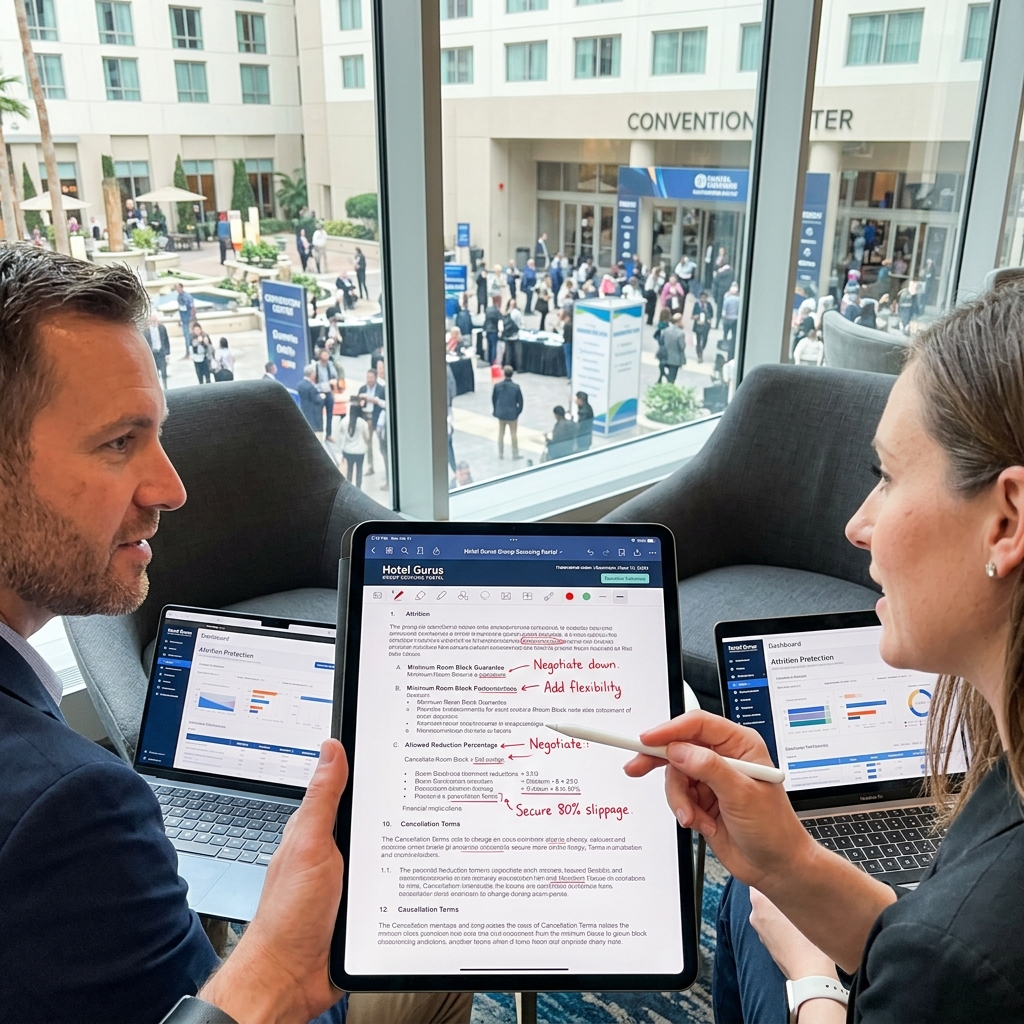
Or worse: the hotel adds an unexpected attrition charge because they interpreted the contract differently than you did. You believe you’re at 88% pickup; they’re claiming 85% triggers 50% liability. You’re caught in a post-event dispute with conflicting interpretations.
We eliminate these surprises.
Complete transparency from the start. When we present hotel options, every number is all-in. We list the room rate, every daily fee, taxes, and any applicable concessions. No hidden charges in small print. You see the true cost per room before you commit.
Clear contract language on billing. Our contracts specify exactly how attrition is calculated (pickup percentage? room count? both?), which charges are taxable, which are waived, and when final invoices are due. We build in dispute resolution language so disagreements don’t fester.
We handle billing reconciliation. You don’t email the hotel asking about a line item on the invoice. You contact us. We review the invoice against your contract, flag any discrepancies, and work with the hotel to correct them. We’re the intermediary protecting you from post-event surprises.
Pre-arrival final counts. We work with you to get an accurate final room count 14-21 days before arrival. We communicate that count officially to the hotel, in writing, so there’s no ambiguity about your pickup number for attrition calculation. This removes the most common source of post-event disputes.
Rate and fee lock-in. Everything is locked in writing before guests arrive. No surprise rate increases, no late-applied fees, no “market adjustments.” If the hotel tries to charge something not in the contract, we have documentation to push back.
Simplified final billing. You don’t juggle invoices from five hotels. We consolidate billing so you’re reviewing one summary report showing rooms booked, charges applied, concessions credited, and your final balance. Clean. Simple. Understood.
Being your single point of contact means you’re protected from the complexity. Hotels have no direct billing relationship with you; they have it with us. We absorb the operational friction and deliver you clean numbers.
Actionable takeaway: For your current program, compile all hotel invoices and proposals side-by-side. Highlight every fee that wasn’t explicitly mentioned in the initial proposal. That’s where billing surprises hide. Ask your hotels to eliminate or waive the least defensible ones.
How We Secure the Best Terms for Your Group
Attrition protection is our foundation, but securing the best overall terms for your group requires negotiation across multiple dimensions.
Here’s our comprehensive approach:
Market benchmarking. We know what competitive rates are in every market, in every season, for every property type. When we receive initial proposals, we can immediately assess whether they’re competitive or padded. If they’re padded, we have data to negotiate down.
Volume leverage. We manage hundreds of room blocks annually. Hotels recognize that sourcing through Hotel Gurus isn’t a one-off inquiry; it’s a signal of consistent business. That volume creates leverage. We’re not negotiating as a solo event planner with one event; we’re negotiating as a strategic partner with ongoing account value.
Relationship depth. We don’t just talk to the hotel’s sales office. We know the revenue managers (who control rates), the operations directors (who manage attrition), and the VPs of sales (who can override policies). That depth means our requests get serious consideration and creative solutions.
Creative bundling. Instead of asking for the lowest rate and hoping for concessions, we bundle requests. Lower rate plus complimentary upgrades plus fee waivers plus flexible attrition equals a comprehensive deal that’s better than any single concession. Hotels see value in the package and are more willing to move.
Alternative options. We always have alternatives. If the preferred property won’t budge on attrition terms, we pivot to properties that will. Hotels know this. That competitive pressure encourages them to be reasonable.
Contract language clarity. We draft or review every contract. Ambiguous language in hotel contracts is intentional—it gives hotels flexibility at final billing. We eliminate ambiguity in your favor. Clear terms mean no disputes, no surprises, and faster billing.
Timing strategy. We source early enough that hotels want your business (because their block is still open), but late enough that you have committed registration data (so attrition terms are realistic). That window is where the best deals happen.
Performance guarantees. We back up our recommendations with our reputation. When we say a property offers strong attrition terms and fair rates, we’re staking our relationship on that. Hotels respond to that accountability.
The end result: hotel room blocks for events that are competitively priced, fairly structured, and protected from attrition risk. You get better terms than you could negotiate solo, faster sourcing than standard processes allow, and zero cost for the service.
Actionable takeaway: Before your next RFP, list your three biggest negotiation priorities (rate, attrition terms, concessions). Share those with your sourcing partner upfront. Focused negotiation beats generic sourcing every time.
—
Event planning is complex enough without hotel logistics becoming a financial liability. Attrition risk, rate protection, contract disputes, and multi-property coordination are problems we’re built to solve. We handle everything so you can focus on delivering the event itself.
Our service is completely free to you—hotels pay us, not you. We’ve already built relationships and expertise; your event just benefits from them. Whether you’re managing a 100-room corporate retreat or a 1,000-room conference, we source faster, negotiate better terms, and protect your program from the risks that surprise other planners.
Ready to see how we work? Save time and money by letting us source your next group. Tell us your dates, group size, and locations—we’ll deliver solid options within days.
Frequently Asked Questions (FAQ)
What exactly is attrition protection and why does it matter for our hotel room block?
Attrition protection is a contract clause that shields you from steep penalties if your group doesn’t fill every room you’ve blocked. We negotiate attrition terms that define what happens if your numbers drop—whether that’s a sliding scale penalty, a grace period, or flexibility to reduce your block without financial consequences. Without solid attrition language, you could face thousands in unexpected charges if your final headcount falls short of your original commitment.
How do we handle attrition clauses differently than typical sourcing platforms?
We negotiate attrition terms on your behalf as part of our contracting process, not as an afterthought. We push for language that actually protects your program—including rate protection, cancellation flexibility, and concession clauses that give you wiggle room. Because we work directly with hotel decision-makers and understand their constraints, we can structure attrition agreements that feel fair to both sides rather than leaving you stuck with one-size-fits-all contract templates.
Do you charge us for this attrition negotiation and contract protection?
No. We handle everything at no cost to you—hotels pay us, not you. Our fee comes directly from the properties we source, which means you get expert contract negotiation, attrition protection, and risk management without adding a single line item to your budget.


